From the Swindon Advertiser... They climbed the wrong mountain and two got lost! 9:03pm Tuesday 3rd May 2011 By Katie Bond » A CRUCIAL wrong turning, a mountain rescue emergency call and three injuries were just some of the disasters which struck Team Wayne as they attempted the Three Peaks Challenge. But despite their errors, the group of friends – who were attempting to climb the highest mountains in Scotland, England and Wales within 24 hours – have raised nearly £10,000 for Leukaemia And Lymphoma Research in memory of Wayne Wilson. READ THE FULL ARTICLE HERE >>>
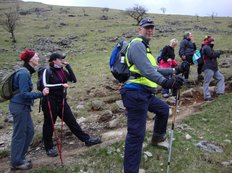 Brown Tongue - Training Weekend Are You Training For A Three Peaks Challenge?Last weekend (26th & 27th March 2011) saw 30 budding Three Peaks Challengers attending the Merseyventure Three Peaks Challenge Training Weekend at Nether Wasdale, Wasdale Head, and Scafell Pike. The first session was held in and around Nether Wasdale, and included Safety, Planning, and Basic Navigation, with a safety talk from members of Wasdale Mountain Rescue Team. The day also included 4 hours of navigation, route finding and map reading skills in the valley. Saturday evening saw 20 walkers taking part in an epic mountain adventure, climbing Scafell Pike as daylight fell, then descending via various routes in thick mist and darkness. The following day saw a group complete the climb in daylight, with good, clear conditions.If you are attempting the challenge in 2011, Merseyventure can provide a bespoke training day or weekend for you - please contact www.merseyventure.org for details.
Saturday 19th February 2011, come and join us attempting a winter circuit of the Yorkshire Three Peaks Challenge. Enjoy the Yorkshire Three Peaks in Winter..!This is our first Open Challenge event for 2011. We invite a maximum of 20 individual walkers to attempt the Yorkshire Three Peaks Challenge in winter..! Depending upon conditions at the time, you may be walking for some 14-15 hours over this 24.5 mile circular route. You will visit the summits of Pen-Y-Ghent, Whernside and Ingleborough, and see some spectacular winter landscapes. Meeting up on Friday evening in our bunkhouse in Horton-In-Ribblesdale with overnight accommodation included, you will get to meet our team, and the other challenge walkers, and perhaps enjoy a few pints in the Golden Lion. Saturday morning sees a cooked breakfast in the bunkhouse, and an early start heading out to Pen-Y-Ghent. Our guide will lead you (in gropus of 6-8 walkers) and encourage you, and we will have hot drinks available for you at various points enroute as you tackle this challenge route. We will also have return transport available to anyone who should need it. After a successful ascent of Whernside and Ingleborough, you will return to Horton for medals and photo’s, and again - perhaps a few pints at the Golden Lion Hotel. Second night accommodation is included at the bunkhouse. Sunday morning, say our goodbye’s and return home... How much does it cost?Entry is £75 per person, payable in full at the time of booking. Places are strictly limited to 20 individuals. No fundraising requirement - however, you may wish to raise funds for a charity or good cause and donate any funds raised directly to them. Charity entrants should enter/pay online in the normal manner. What’s included?* Friday & Saturday night in the 3 Peaks Bunkbarn * Breakfast on Saturday morning * Experienced mountain guide (max ratio 1:8) * Hot drinks and support enroute * Return to base transport if required * Medal for all finishers What’s not included?* Transport to/from Horton-In-Ribblesdale * Food & drinks for the weekend apart from that detailed above * Personal accident/injury insurance ***ONLY 4 PLACES REMAINING*** To enter online, click this link: WINTER THREE PEAKS CHALLENGE
Three Peaks Challenge 2011Want to enter your team into a Three Peaks Challenge event in 2011, but don't want to have to raise some £5000 for a charity you may have no real interest in? Want to raise funds for your own charity or good cause? Or just want to attempt the challenge at the same time as a number of other teams, with full safety support in place? The Open Challenge Series 2011 includes 3 Open Three Peaks Challenge events, all starting at Fort William for Ben Nevis, and finishing in Llanberis for Snowdon. Teams must consist of 4-8 walkers (depending upon event) and 2 drivers. Teams will organise their own transport, accommodation and food for the challenge, and will be aiming for a true 24 hour challenge attempt, starting at 5 minute intervals from the Glen Nevis Visitor Centre. You can secure your team place online now from £149 deposit, with the balance payable 28 days before your challenge. Your team entry fee includes: - Beacon Map / Guide Set
- Pre-event training, route and equipment information
- Training Days at Wasdale
- Registration in Fort William hotel
- Pre-event safety briefing in hotel
- Kit issue for loan of safety equipment:
- VHF radios
- Emergency group shelters
- Lightweight cooker and fule
- Event bibs and vehicle ID
- Sport Ident timing dibber
- Sport Ident results at finish
- Parking and rubbish removal
- Qualified & experienced mountain staff on each mountain
- First aid trained support staff at mountain bases
- Finish at Royal Victoria Hotel, Llanberis
- Medals & certificates for all finishers
- Buffet & awards at finish
- Event liability insurance
Our Open Challenge events for teams in 2011 are:Spring Stroller - 7th/8th May 2011Corporate Team Challenge - 24th/25th June 2011Die Hard Trilogy - 3rd/4th September 2011...And for those of you who have completed a Three Peaks Challenge - try the Three Peaks Mountain Rally Challenge - you could win £1000 cash...!
The Three Peaks Challenge advcie and help group on Facebook now has over 650 members, with lots of useful links, tips, maps, etc. Why not drop in and see if it can help you? http://www.facebook.com/group.php?v=info&gid=11016265439 Also on Twitter @richieev and @Mersey_VentureThree Peaks Challenge website
Hello All, Well it's time we did some work on our Facebook Group, and the Merseyventure Fan Club...! We've already got 180 members in our 3 Peaks Information Group, and I'll post some Merseyventure Club Info below: THREE PEAKS FACEBOOK GROUP
Youth Cancer Trust Teams Complete 3 Peaks Challenge
On Saturday 24th May 2009, 5 teams assembled at the Chase The Wild Goose Hostel in Banavie, nr Fort William, to register for the Youth Cancer Trust - Three Peaks Challenge.
The Challenge is to climb, and travel between, the highest UK mountains of Ben Nevis (Scotland), Scafell Pike (England) and Snowdon (Wales), all within a continuous strictly timed schedule of around 24 hours. The challenge involves driving some 480 miles between the peaks, walking some 26 miles, and climbing over 10,000 feet.
Teams represented Scottish Widows, Barclays, CHF Creative, Cuddles Day Nursey and Nigel Bradley entered a team made up from his company and it's suppliers.
The forcast was for heavy rain and strong winds on Ben Nevis, but improving as the event developed and moved south. The prediction proved true, with all teams getting a soaking on the Ben, with a mixture of snow and hailstones waiting for teams on the summit area, with deep slush and snow remaining underfoot from the winter.
All teams completed the Ben Nevis climb on target, and swiftly headed off to Wasdale for the next climb - Scafell Pike. The conditions here were much more inviting, but having to climb and navigate in the dark, with only the clear skies and stars to help, careful navigation was important to ensure teams did not stray off the prescribed route. Latter teams were treated to an impressive Lake District sunrise.
Teams then started the final drive to Llanberis, Snowdonia, for the last of the Three Peaks - Snowdon. The sun was now shining, and tired teams needed to ensure they had plenty of liquids available for this climb up a very popular and busy mountain. Temperatures of 73 degrees were recorded at the finish, the Heights Hotel, in Llanberis, where drivers and support teams would await their walkers.
After just 23 hours and 45 minutes after starting the Ben Nevis climb, the first team arrived at the finish - WELL DONE..! Within a few hours all other teams had successfully completed the challenge, and also raised a huge amount of much needed funds for the Youth Cancer Trust.
Many thanks to everyone who took part, and helped acheive so much during this weekend.
Richie..
Three Peaks of Yorkshire - Top Tips.
For those of you wishing to try and climb Pen-Y-Ghent, Whernside and Ingleborough in 2009, here's some tips and advice to help you on your 24 mile challenge walk..! Please feel free to add you comments or observations if you've walked this route before.
1. Make sure you get an early start..! The earlier the better. If you have started walking by 7am, then you can aim to finish around 7pm, and possibly have a little time spare for food breaks enroute. Any later starts risk not only a finish in the dark - but possibly even arriving back at the finish after they've finished serving food - disaster...
2. Carry spare socks. The section across the moss, just after completing Pen-Y-Ghent, is always boggy. Even in dry weather, you are unlikely to reach Ribblehead with dry feet. Wet feet & wet socks will ensure blisters well before the end of the challenge - so ensure you at least have spare socks, but also consider some foot powder and blister pads (compeed etc).
3. Carry some money. Ribblehead has a Public Inn, and usually a mobile catering van. Chapel-Le-Dale also has a Public Inn, and the farm just before the Inn often serves snacks to walkers. Also bear in mind any walkers wishing to retire at the above - carry emergency money for a train or taxi home.
4. Get to know the route. Check out the route fully before you start, and read the many route descriptions and trip reports. Get a good idea of where other walkers had any problems with underfoot conditions or navigation.
5. Carry the right kit. I assume that in reading this blog, you are fully aware of the right clothing and equipment you should be carrying to ensure your own safety and comfort during this challenge walk. If not, check the equipment list here.
Scafell Pike - Top Tips
1. Don't underestimate just how difficult this mountain can be when navigating in poor visibility. Pay a visit to the area before your challenge, and have a training walk so you are familiar when you return.
2. Many mistakes are made by trying to return back from the summit too quickly. Steady accurate progress down the mountain is much better than rapid progress in the wrong direction.
3. The paths underfoot are rocky and loose, and very slippery when wet. You will need to cross the Gill if using the route from Wasdale. Always wear walking boots with ankle protection - not training shoes.
4. Always carry a head torch and spare batteries, even if you do not intend to still be on Scafell Pike in the dark. Hi-viz jackets and rear LED lights or glow-sticks are an ideal way to help a team stay together.
5. Groups should stay together in poor visibility. It is very easy to get split up, and even pass each other without realising it. One common reason for failing to complete the challenge within a 24 hour period is time lost searching for team members on Scafell Pike in the dark.
6. Beware of becoming confused by other head torches on the mountain. It is very easy to be drawn towards other teams, only to discover they are lost, or are attempting a different route.
7. Stick to made-up paths, and route with cairns. Once you lose the path underfoot, or lose sight of cairns, it can be difficult and confusing trying to rediscover the correct route. Walking on the fell or grass adds to errosion of the area and should be avoided.
8. If possible, try to remain in contact with your support vehicle, and other team members, by using handheld VHF radios. Mobile phones will not work in the Wasdale or Seathwaite valley - but both do have a public telephone available (credit card may be required).
9. Your team should use the motorway services to have a break, get a hot drink, fuel up your vehicle, use the toilets, dispose of rubbish, fill up water bottles, change maps, sort out your kit and rucsac ready for Scafell Pike. Idealy you should be able to arrive and start walking - Wasdale and Seathwaite have no facilities, no water available, and no street lighting. Arrive fully prepared..!
10. Please respect these quiet and remote locations.
Both areas are sensitive and are surrounded by working farms, campsites, B&B's, etc. Please keep any noise and disruption to an absolute minimum. Arrive quietly and turn your engine and headlights off. Don't slam vehicle doors, play loud music, or shout to each other.
Park considerately in designated parking areas - taking care not to block access for local traffic or Mountain Rescue Services.
Remove all rubbish you create, and use motorway service toilets, not behind walls, trees and bushes..!
Ben Nevis : Scafell Pike : Snowdon : Driving Route : General Information : Gallery : Fitness : Links : Transport : Open Challenge Series 2009
Will it be sunny? Will we need our waterproofs? Can we wear trainers?
Just some of the questions I get asked regarding the possible weather conditions on the Ben Nevis summit in summer. Well, the summit is likely to be 15 degrees colder than the Glen Nevis car park, and conditions can change very quickly on the summit. You should be prepared for pretty hostile conditions, but hopefully may get some great, clear weather.
However, check the YouTube video below which shows what it MAY be like in mid-June....
|
 RSS Feed